The weakest-cell problem
Picture a team of workers passing buckets along a chain. It does not matter how strong the best worker is — the chain moves at the pace of the slowest. A lithium battery is exactly this. Its cells are wired in series, so the same current flows through every one of them, and the whole pack must stop when any single cell reaches its limit.
Now imagine one cell holds slightly less charge than its siblings. During charging it fills up first, so the BMS must stop the charge while every other cell still has room. During discharge it empties first, so the BMS must cut the power while the others still hold energy. The pack behaves as if it were smaller than it is — not because energy is missing, but because it is misaligned.
That misalignment is called imbalance, and the process of correcting it is cell balancing. It is arguably the least understood job a battery management system performs, and the one most surrounded by workshop mythology. By the end of this article you will know precisely what the balancer in your pack does, what it cannot do, and how to watch it working in real time from your phone.
Why identical cells drift apart
Cells leave the factory matched, so why do they drift? Three quiet mechanisms, all of them unavoidable:
- Manufacturing tolerance. Two “identical” cells differ fractionally in capacity and internal resistance from the day they are made. Grading narrows the spread; nothing eliminates it.
- Temperature gradients. Cells in the middle of a pack run warmer than cells at the edge. Warmer cells self-discharge faster and age faster, so position alone creates drift. This is one reason packs in hot climates — e-rickshaws being the classic case — drift more than datasheets suggest.
- Self-discharge differences. Every cell leaks a little charge internally while resting. The leak rate varies cell to cell, and months of small differences compound.
Drift is therefore not a defect — it is entropy. A pack without balancing does not stay balanced; it degrades towards uselessness even if every cell remains individually healthy. The balancer is the housekeeping that pushes back.
Passive balancing: burning off the difference
Passive balancing is beautifully crude. Across each cell, the BMS has a small resistor and a switch. When one cell's voltage runs ahead of the others near the top of charge, the BMS closes that cell's switch and lets the resistor quietly burn off the excess as heat. The fuller cells are held back, the emptier cells catch up, and the team crosses the finish line together.
Why it happens near full charge
Lithium cells — especially LiFePO4 — have a stubbornly flat voltage curve in the middle of their range, so mid-charge voltages reveal almost nothing about which cell is fuller. Near the top, the curve steepens sharply and differences finally become visible. That is when the balancer can act with confidence, which is why balancing effectively only runs during the final phase of charging — and why packs that never get a full charge never get balanced.
Why it is slow
The bleed resistors are tiny, typically passing 30 to 60 milliamps. That is deliberate: the resistors live on a crowded circuit board and cannot dump much heat. But it means correcting even a modest imbalance takes hours of top-of-charge time — the worked example below puts real numbers on it. Slow is not broken. Slow is the design.
Active balancing: moving charge instead
Active balancing takes the elegant route: instead of burning the excess, it moves it. Using small capacitors or inductors as shuttles, the balancer grabs charge from the fullest cell and delivers it to the emptiest — energy is redistributed rather than wasted.
The advantages are real. Active balancers work across the whole charge range, not just at the top. They move far more current — one to five amps rather than milliamps — so corrections take minutes to hours rather than days. And on large packs, the energy saved from not bleeding matters.
So why doesn't every pack have one? Cost and complexity. An active balancer needs switching circuitry per cell and careful control, which adds real money to a board otherwise built to a price. On a small commuter pack the recovered energy never pays back the hardware. On a large solar bank or an expensive EV pack, it often does. Both approaches keep a healthy pack aligned; they differ in speed, efficiency and price, not in principle.
Active vs passive compared
| Passive balancing | Active balancing | |
|---|---|---|
| Method | Bleeds excess through resistors as heat | Shuttles charge between cells |
| Typical current | 30–60 mA | 1–5 A |
| When it works | Near top of charge | Across the full range |
| Energy | Wasted as heat | Mostly recovered |
| Correction speed | Hours to days | Minutes to hours |
| Cost | Cheap, standard on most BMS boards | Meaningfully more expensive |
| Best suited to | Commuter packs, e-rickshaws, e-bikes | Large solar banks, premium EV packs |
Top balancing vs bottom balancing
A brief detour for the DIY crowd, because the terms cause endless confusion. Top balancing aligns all cells at full charge — the pack delivers its maximum capacity, and the top is where the BMS balances thereafter. This is the right choice for essentially every consumer application, and it is what your BMS does. Bottom balancing aligns cells at empty instead; it has a niche following in applications that routinely run packs to the floor without per-cell low-voltage protection. For any pack with a proper BMS — which is any pack you should own — top balancing is the answer, and the debate is academic.
How long balancing takes: a worked example
Let us put real numbers on the “why is my pack still unbalanced?” question. Suppose one cell in a 100 Ah LiFePO4 pack sits 2 amp-hours behind its siblings — a 2% imbalance, enough to trim range noticeably.
- Passive balancer at 50 mA: the balancer must bleed the other cells' excess relative to the low one. Correcting a 2 Ah misalignment at 0.05 A takes roughly 40 hours of active balancing time. Since the balancer only works during the top-of-charge window — perhaps 30–60 minutes per full charge — that is several weeks of daily full charges.
- Active balancer at 2 A: the same correction takes about an hour of runtime, achievable in a single session.
Two lessons fall out of the arithmetic. First, passive balancing is maintenance, not rescue: it holds an aligned pack aligned, but it corrects a badly drifted pack only over weeks of patient full charges. Second, the common habit of never fully charging — kind to the cells in other ways — silently starves the balancer of its working window. The practical compromise: shallow daily charges, plus one deliberate full charge with taper every few weeks. Conveniently, that is the same routine that keeps the fuel gauge honest, as covered in the SOC accuracy guide.
Watching balancing live in BATBMS
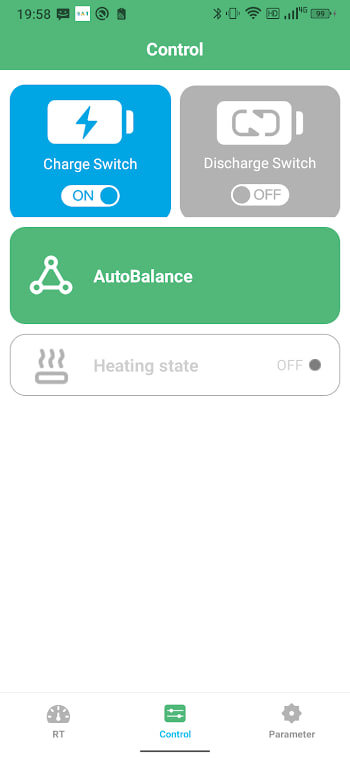
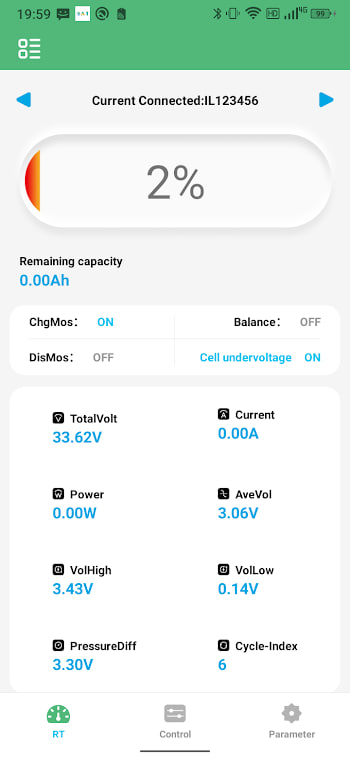
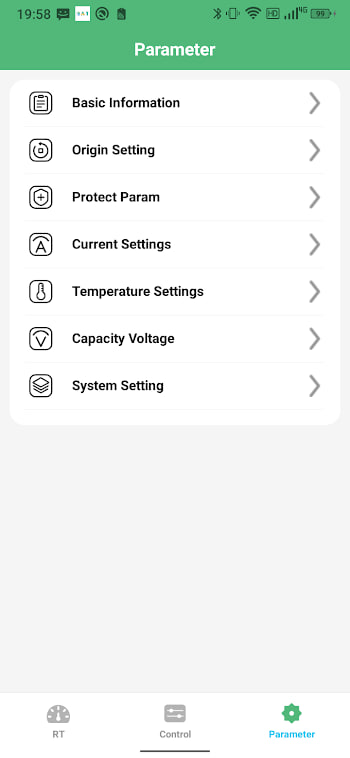
The lovely thing about a smart BMS is that none of this is theoretical any more. Connect the BATBMS app during the final phase of a charge and you can watch housekeeping happen:
- Cell voltages converging. The spread between highest and lowest cell — the delta — shrinking as full charge approaches is balancing working as intended.
- Balance indicators. On supported boards, the app flags which cells are being bled at that moment. Seeing the same cell flagged charge after charge tells you which one runs ahead.
- The delta as a health number. A pack that finishes its charge with cells within about 0.01–0.03 V is in fine shape. A delta that keeps widening at rest, or a cell that repeatedly sags under load in the cell voltage view, is telling you something balancing cannot fix.
If you have never looked, it is worth connecting during the last twenty minutes of a charge simply to see it — the moment the abstract concept becomes a row of numbers pulling into line. (New to the app? Start with the connection guide.)
When balancing cannot save a pack
Balancing corrects alignment. It cannot correct capacity. The distinction decides whether your pack has a maintenance problem or a mortality problem.
A drifted-but-healthy pack balances back to full performance: all cells still hold their rated capacity; they were merely out of step. But a cell with genuinely reduced capacity — from age, heat, or a manufacturing flaw — will fill first and empty first forever, no matter how perfectly it is balanced at the top. The balancer will dutifully re-align it every charge, and every discharge it will hit the floor early anyway. The signature is unmistakable: balancing “works” each night and the problem returns each day.
The same is true of a cell with high internal resistance, which sags under load regardless of its state of charge. Both conditions show up clearly in per-cell data long before they strand you, which is the practical argument for glancing at the app monthly — the battery health guide covers what to record. When one cell is genuinely dying, the choices are a cell-group replacement or a new pack; no balancer, passive or active, resurrects chemistry.
Manual rebalancing and its risks
Workshops sometimes offer “manual balancing” — charging individual low cells with a bench supply to bring a badly drifted pack back quickly. Done competently, it is legitimate; hobbyists with good equipment do it routinely. But understand what it involves before anyone opens your pack: working across live cell groups where a slipped tool can weld itself to a bus bar, setting precise per-chemistry voltage limits where a wrong digit destroys a cell, and knowing that if the drift returns within weeks, the pack had a capacity problem all along and the exercise was cosmetic.
For most owners the sensible ladder is: give the built-in balancer weeks of proper full charges first; escalate to a shop with an active balancer if the delta will not close; and treat cell surgery as the last rung, reserved for young packs where one replaceable group has failed. And through all of it, let the numbers in the app — not anyone's sales pitch — tell you which rung you are on.